Global Commodity Markets Repriced: Energy, Fertilizers and Metals Drive the 2026 Outlook
World Bank forecasts show commodity prices rising 16% in 2026, led by energy, fertilizers and metals. Explore the market reversal, recent price correction and implications for industrial buyers.
World Bank Forecasts a 16% Annual Rise as Middle East Disruptions Transform the Commodity Landscape
Global commodity markets entered 2026 expecting another year of declining prices.
Within months, that outlook changed dramatically.
The World Bank now forecasts that overall commodity prices will rise by approximately 16% in 2026, marking the first annual increase since 2022. The reversal has been driven primarily by disruptions associated with the war in the Middle East, which have affected energy supplies, international shipping and several interconnected commodity markets.
The scale of the change is significant. In January, the World Bank expected commodity prices to decline by approximately 7% during 2026 as weaker oil demand growth and increasing supply weighed on markets.
By April, the forecast had moved in the opposite direction.
Instead of falling 7%, commodity prices were expected to rise 16%.
The shift illustrates how rapidly geopolitical disruptions can alter the economics of global commodity trading — particularly across energy, fertilizers and industrial metals.
From Expected Decline to a 16% Increase
At the beginning of 2026, the global commodity environment appeared relatively bearish.
Oil markets were expected to face abundant supply, global economic growth remained moderate and weaker energy prices were expected to pull the broader commodity index lower.
The Middle East conflict fundamentally changed those assumptions.
Disruptions to energy infrastructure and maritime transportation created a major supply shock. The Strait of Hormuz, one of the world's most strategically important commodity transportation corridors, became a critical source of uncertainty for oil, natural gas, petrochemicals and other internationally traded materials.
As a result, the World Bank's April Commodity Markets Outlook projected that overall commodity prices would rise 16% in 2026.
The forecast represents more than a normal market revision. It shows how quickly commodity fundamentals can change when production, logistics and geopolitical risk move simultaneously.
Energy Leads the Increase
Energy sits at the centre of the revised outlook.
The World Bank forecasts that average energy prices will rise approximately 24% in 2026, reaching their highest level since 2022.
Oil is a major component of that increase.
The World Bank expects Brent crude to average approximately $86 per barrel in 2026, compared with roughly $69 per barrel in 2025.
The importance of higher energy prices extends far beyond the petroleum market.
Oil and natural gas influence transportation, electricity, manufacturing, mining, petrochemical production and agricultural inputs. Higher energy costs can therefore spread through numerous commodity value chains.
Natural gas is particularly important because it functions both as an energy source and as a feedstock for industrial production.
For commodity markets, energy is rarely an isolated category.
It is an input into much of the global industrial economy.
Fertilizer Prices Could Rise 31%
Fertilizers represent one of the most striking elements of the World Bank's 2026 outlook.
Average fertilizer prices are projected to increase approximately 31% during 2026.
Urea is expected to experience an even larger movement, with the World Bank forecasting an increase of around 60%.
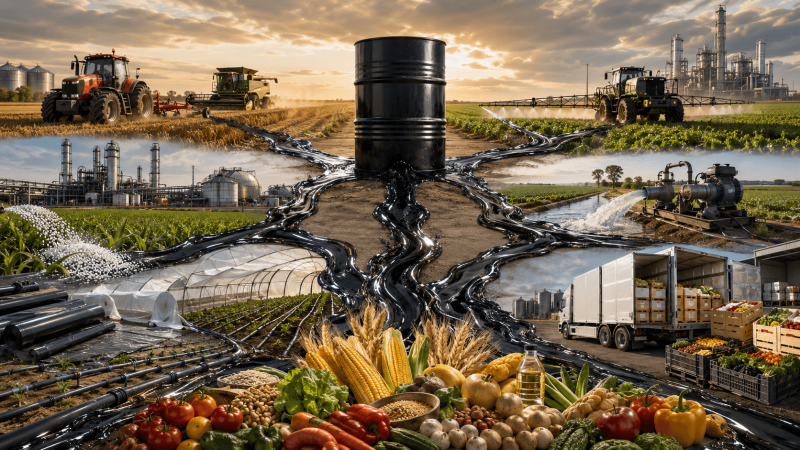
The connection between energy and fertilizers helps explain the magnitude of the pressure.
Conventional ammonia production relies heavily on natural gas. Ammonia then serves as the fundamental building block for nitrogen fertilizers, including urea.
Higher natural gas prices can therefore increase ammonia production costs.
At the same time, disruptions to Middle Eastern fertilizer production and exports can constrain the availability of finished products.
The market is consequently exposed from two directions: higher production costs and tighter physical supply.
For agricultural buyers, the consequences extend beyond the fertilizer market itself.
More expensive fertilizers increase production costs for farmers and can affect fertilizer affordability, application decisions and ultimately agricultural economics.
The World Bank expects fertilizer affordability in 2026 to deteriorate to its weakest level since 2022.
Metals Are Moving Higher Too
The 2026 commodity shock is not limited to energy and fertilizers.
The World Bank expects metals and minerals prices to rise approximately 17% during the year.
Several important base metals, including copper and aluminium, are expected to reach historically high average prices.
Unlike energy, where supply disruption has been the dominant story, metals are also benefiting from powerful structural demand trends.
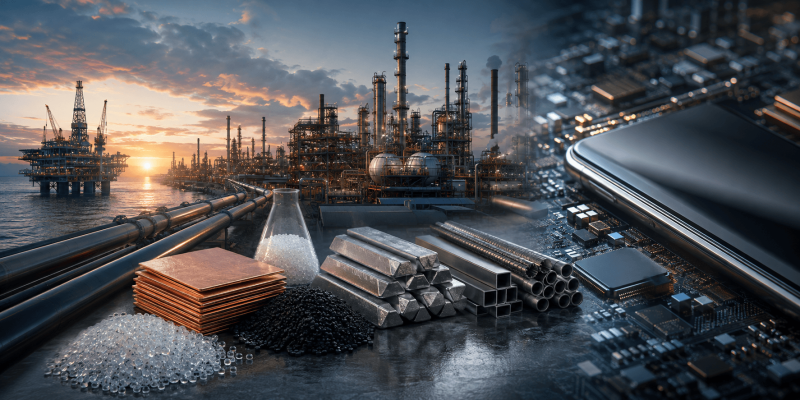
Copper and aluminium are essential materials across electricity networks, construction, transportation, renewable energy systems, electric vehicles, data centres, industrial equipment and manufacturing.
The continued expansion of electrification and digital infrastructure is creating substantial demand for conductive and structural metals.
Copper is particularly important because of its electrical conductivity and its widespread use in cables, motors, transformers, electronics and power infrastructure.
Aluminium combines low weight, corrosion resistance and broad industrial versatility, making it important across transportation, construction, electrical systems, packaging and manufacturing.
The result is a metals market being influenced simultaneously by geopolitical uncertainty and long-term industrial demand.
Why Copper and Aluminium Matter Beyond the Metals Market
The importance of copper and aluminium illustrates another characteristic of commodity markets: raw materials rarely operate in isolation.
A data centre requires enormous amounts of electrical equipment and power infrastructure.
Electric vehicles require conductive metals, aluminium structures, polymers and sophisticated chemical products.
Renewable-energy systems depend on metals, steel and industrial materials.
Electrical grids require copper, aluminium and steel.
Industrial facilities need structural metals, pipes, machinery, lubricants and energy.
Demand generated by one sector therefore spreads into several commodity categories.
This interconnected demand is one reason understanding commodity markets increasingly requires looking beyond individual products.
Petrochemicals Face the Energy Shock
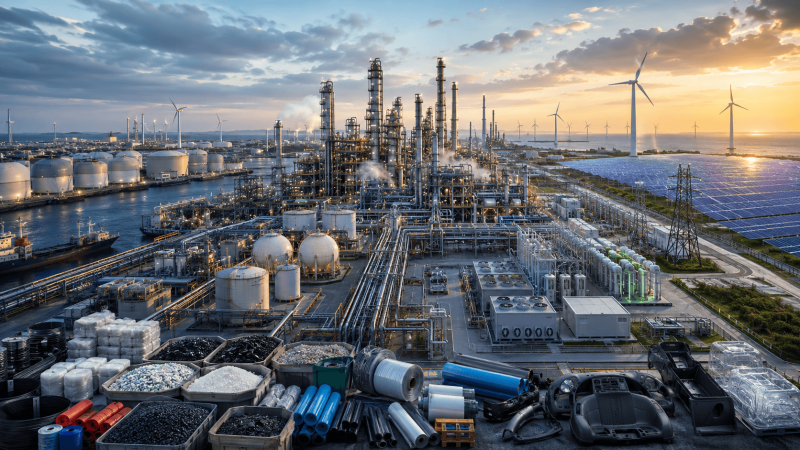
The World Bank's headline forecasts focus on broad commodity categories, but higher energy prices also have important implications for petrochemical markets.
Petrochemical production depends on hydrocarbon feedstocks including ethane, propane and naphtha.
These feedstocks ultimately support the production of major chemical building blocks such as ethylene and propylene.
Those building blocks then enter downstream polymer production.
Ethylene is the principal feedstock for polyethylene products including HDPE, LDPE and LLDPE.
Propylene is used to produce polypropylene.
A disruption in crude oil, natural gas or petrochemical feedstock markets can therefore travel downstream into polymer production economics.
The 2026 Middle East disruption has already demonstrated this relationship, with constraints affecting petrochemical flows and increasing pressure on polymer markets.
For industrial buyers, watching oil and gas markets is therefore not separate from monitoring polymers.
They are different stages of the same value chain.
Agriculture Moves Differently
Not every commodity category is expected to rise.
The World Bank forecasts that overall agricultural commodity prices will decline approximately 6% in 2026.
At first glance, this appears contradictory given the sharp increase expected in fertilizer prices.
The explanation lies in the composition of the agricultural index.
Falling beverage prices are expected to outweigh increases elsewhere, while food prices face upward pressure from higher energy and fertilizer costs.
This demonstrates why broad commodity indexes need to be interpreted carefully.
A decline in an overall category does not necessarily mean every commodity inside that category is becoming cheaper.
Individual markets continue to respond to their own supply, demand, inventory, weather and trade conditions.
June Showed How Quickly Markets Can Reverse
Another important development occurred after the World Bank published its April forecast.
Commodity prices began retreating from some of the extreme levels reached earlier in the conflict.
The World Bank's July 2 Pink Sheet shows this clearly.
Brent crude averaged approximately $120.4 per barrel in April, declined to around $107.5 in May, and then fell further to approximately $85.4 in June.
That is a substantial correction.
It demonstrates an important distinction between an annual price forecast and short-term market movements.
The World Bank's projection that average commodity prices will rise 16% in 2026 does not mean prices will increase continuously throughout the year.
Commodity markets rarely move in straight lines.
Prices can surge following a supply shock, decline when immediate fears ease, and rise again if physical constraints return.
A 16% Annual Increase Does Not Mean Every Commodity Rises 16%
The headline figure also requires careful interpretation.
The projected 16% increase refers to the World Bank's overall commodity price index.
It does not mean copper, aluminium, oil, fertilizers, polymers and agricultural commodities will each increase exactly 16%.
Their expected movements differ substantially.
Energy is projected to rise around 24%.
Fertilizers are projected to increase approximately 31%.
Metals and minerals are expected to rise around 17%.
Agricultural commodities are projected to decline around 6%.
Precious metals are expected to rise much more strongly.
The headline number therefore represents the combined movement of a broad basket of commodity markets.
For buyers and traders, the individual market matters more than the headline average.
What This Means for Industrial Buyers
The 2026 market environment reinforces the importance of procurement strategy.
When prices are volatile, purchasing decisions become more complex.
Buying too early can expose a company to losses if prices decline.
Waiting too long can leave a buyer exposed to another price increase or physical shortage.
Availability can also become as important as price.
During periods of geopolitical disruption, the cheapest quoted cargo has limited commercial value if it cannot be loaded, shipped or delivered reliably.
Buyers therefore need to consider several variables simultaneously:
product specification, origin, producer availability, inventory, price, freight, shipping routes, delivery schedules and geopolitical exposure.
Commodity procurement becomes a risk-management function as much as a purchasing function.
Supply Diversification Becomes More Valuable
The 2026 disruption has also highlighted the risks associated with concentrated supply chains.
A company may believe it has several suppliers while discovering that all of them depend on the same producing region, feedstock source, port or maritime chokepoint.
True diversification requires looking further upstream.
Where was the commodity produced?
Where did its feedstock originate?
Which export terminal does it use?
Which maritime route must the cargo cross?
What alternative origins are technically and commercially viable?
These questions become especially important for petrochemicals, fertilizers and energy products whose production and exports can be geographically concentrated.
Why Market Intelligence Matters More in Volatile Markets
Rapid changes in the World Bank's 2026 outlook demonstrate another important lesson: historical assumptions can become obsolete quickly.
A buyer relying on the January outlook would have expected commodity prices to decline.
Only months later, the market environment had fundamentally changed.
This is why commodity companies need to monitor more than spot prices.
Production outages, plant operating rates, freight markets, feedstock prices, export restrictions, geopolitical developments, inventories and alternative supply origins can all provide important signals.
The purpose of market intelligence is not to predict every price movement correctly.
That is impossible.
Its value lies in recognizing changing risks early enough to make better commercial decisions.
Prime Petrochem in a Changing Commodity Environment
The World Bank's 2026 outlook is particularly relevant to the markets in which Prime Petrochem operates.
Energy products sit at the centre of the current commodity shock.
Petrochemical and polymer markets are influenced by changing feedstock costs and supply disruptions.
Fertilizer markets face some of the strongest projected price increases of any major commodity category.
Copper, aluminium and other industrial metals continue to benefit from strong demand linked to electrification, infrastructure and industrial development.
These markets are different, but their supply chains repeatedly intersect.
Prime Petrochem operates across this interconnected commodity environment, connecting buyers and suppliers across petrochemicals, polymers, fertilizers, energy products, metals and other industrial materials.
During volatile market conditions, the commercial challenge goes beyond finding a commodity at a particular price.
Origin, specification, availability, logistics, documentation and reliability all become part of the transaction.
2026 Is a Reminder That Commodity Markets Can Change Fast
Perhaps the most important feature of the World Bank's latest forecast is not the 16% figure itself.
It is how quickly the outlook changed.
At the beginning of 2026, commodity prices were expected to fall.
A geopolitical shock changed energy flows.
Energy prices increased.
Fertilizer markets tightened.
Metals continued climbing.
Trade routes came under pressure.
Within months, an expected annual decline had become a projected increase.
Markets have since pulled back from some of their wartime peaks, showing that volatility can work in both directions.
But the broader lesson remains.
Commodity markets are interconnected, global and highly sensitive to changes in physical supply.
For industrial buyers, traders and manufacturers, 2026 is demonstrating that understanding those connections is no longer optional.
It is part of managing supply.