Sulfur Supply Crisis Hits Fertilizer Production as Prices Reach Record Highs
Sulfur prices reached record highs in May 2026 as Middle East supply disruptions squeezed fertilizer margins and forced production cuts in Egypt and Brazil, raising concerns over global phosphate fertilizer supply.
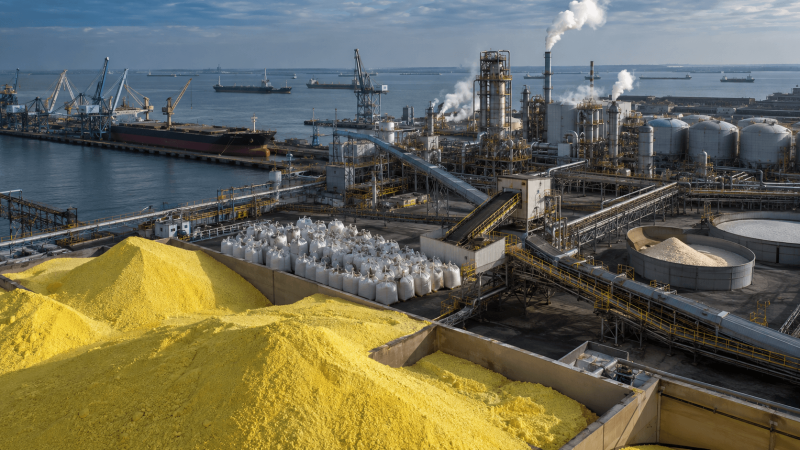
Late May 2026 — Global sulfur markets are experiencing an extraordinary supply shock, with record prices beginning to force fertilizer producers to reduce or temporarily halt production. The disruption demonstrates how quickly constraints in the sulfur market can move downstream into phosphate fertilizers and, potentially, the wider agricultural supply chain.
Sulfur prices surged following the outbreak of the Middle East war on February 28, 2026, as disruption around the Strait of Hormuz restricted one of the world's most important sulfur export corridors.
According to S&P Global Commodity Insights, sulfur prices reached record levels of approximately $815-$820 per metric ton FOB Middle East and $1,200/mt CFR Brazil on May 28.
For fertilizer producers, this is no longer simply a raw-material price increase.
It is becoming a production problem.
Why Sulfur Prices Have Exploded
The Strait of Hormuz is strategically important not only for crude oil and LNG but also for sulfur.
Large quantities of sulfur are recovered from oil refining and natural-gas processing across the Middle East before being exported to fertilizer and chemical producers around the world.
According to S&P Global CERA analysis cited in the market report, disruption to the Strait affected a trade route that normally handles approximately 40,000-50,000 metric tons of sulfur per day and nearly 47% of global seaborne sulfur exports.
That is an enormous concentration of global supply.
Once those volumes became difficult to move, buyers were forced to compete for alternative cargoes from other producing regions.
The result was a rapid transition from a tight sulfur market into a genuine supply crisis.
Egypt's EFIC Halts SSP Production
The consequences are already visible in fertilizer manufacturing.
Egyptian Financial & Industrial Co. (EFIC) began maintenance across its three granular Single Superphosphate (SSP) plants on May 21.
According to a source cited in the original market report, high sulfur costs were behind the decision, with producers waiting for sulfur prices to decline before returning to normal operations.
The significance goes beyond one Egyptian producer.
SSP production depends on sulfur-derived sulfuric acid to process phosphate rock. When sulfur becomes exceptionally expensive, the economics of phosphate fertilizer production deteriorate even if phosphate fertilizer prices themselves remain relatively strong.
At a certain point, continuing to operate can become less attractive than reducing production.
Mosaic Cuts Production in Brazil
The effects have become even more significant in Brazil.
Mosaic announced temporary suspensions of phosphate rock production at its Catalão mine and chemical complex in Goiás for 45 days and its Tapira mine complex in Minas Gerais for 30 days, effective June 1.
The company cited sulfur supply difficulties and rapidly rising raw-material costs.
According to Mosaic, sulfur costs had increased from roughly $100/mt to more than $1,200/mt, representing an increase of around 1,100%.
The company characterized the situation as the industry's most severe sulfur supply crisis since 2008.
This illustrates how an apparently specialized commodity can become a constraint on an entirely different global industry.
Why Fertilizer Producers Need So Much Sulfur
Sulfur is deeply connected to phosphate fertilizer production because it is used to manufacture sulfuric acid (H₂SO₄).
Sulfuric acid is then used to process phosphate rock into forms that can ultimately become major phosphate fertilizers such as:
- Diammonium Phosphate (DAP)
- Monoammonium Phosphate (MAP)
- Single Superphosphate (SSP)
The quantities involved are substantial.
Mosaic stated that approximately 4 metric tons of sulfur are required for every 10 metric tons of DAP or MAP fertilizer produced.
That relationship explains why fertilizer producers cannot simply absorb an extreme sulfur price increase as a relatively minor input-cost adjustment.
When sulfur prices multiply, the economics of phosphate production can change dramatically.
The Sulfur-to-DAP Relationship Has Broken Historical Norms
Another indication of how unusual the current market has become comes from the relationship between sulfur and DAP prices.
Itafos CEO David Delaney said during the company's May 4 earnings call that sulfur historically traded at approximately 30%-35% of the price of DAP.
During the current crisis, he said the sulfur-to-DAP ratio had exceeded 130%, with sulfur offers in Abu Dhabi reaching approximately $1,000/mt.
That represents a fundamental distortion in phosphate fertilizer economics.
The raw material required to manufacture the fertilizer can, under these conditions, become extraordinarily expensive relative to the value of the finished fertilizer itself.
This is why production curtailments matter.
The market is approaching a point where the question for some producers is no longer simply:
“How much sulfur should we buy?”
It becomes:
“Does it still make economic sense to produce phosphate fertilizer at current sulfur prices?”
Brazil Is Particularly Exposed
Brazil represents one of the most vulnerable major agricultural markets because of its dependence on imported sulfur and sulfuric acid.
According to S&P Global CERA analysts, Middle Eastern sulfur represented approximately 42% of Brazil's sulfur imports in 2025.
Replacing those volumes quickly is difficult.
Canada represents one potential alternative source, but available Canadian sulfur volumes have reportedly become increasingly constrained as cargoes are booked forward.
Geography also matters.
A buyer does not simply need to locate sulfur somewhere in the world. The material must be available in sufficient quantities, at the correct specification, with appropriate port infrastructure and commercially viable freight to the destination.
When a major supply region becomes constrained, replacement cargoes can therefore become dramatically more expensive.
Sulfur Has Become a Strategic Commodity for Agriculture
The current crisis reveals something important about sulfur.
It is often viewed primarily as a by-product of the oil and gas industry.
Modern sulfur supply is closely connected to oil refining and natural-gas processing, where sulfur compounds are removed from hydrocarbon streams and recovered as elemental sulfur.
But the demand side tells a very different story.
A substantial part of global sulfur consumption ultimately supports the fertilizer industry.
This creates an unusual industrial chain:
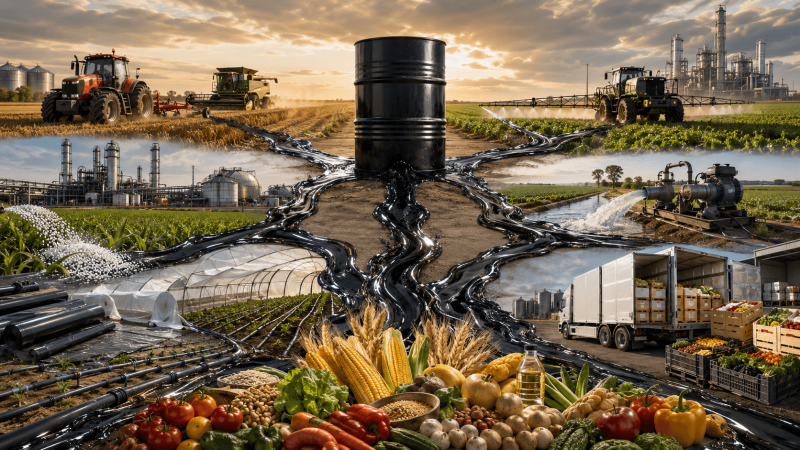
Oil & Gas Processing → Recovered Sulfur → Sulfuric Acid → Phosphate Fertilizers → Agriculture
A disruption beginning in the hydrocarbon sector can therefore move through the chemical industry and eventually reach agricultural production economics.
The current market is a powerful example of how interconnected global commodity supply chains have become.
The Next Risk: Fertilizer Availability
The immediate consequence of expensive sulfur is pressure on fertilizer producer margins.
The second-stage consequence is potentially more important.
If high sulfur prices persist and additional phosphate producers reduce operating rates, the market could begin losing fertilizer production.
Lower operating rates can tighten the availability of DAP, MAP, SSP and other phosphate products, depending on regional inventories, demand and the duration of the disruption.
That could eventually provide upward pressure on phosphate fertilizer prices.
There is therefore a potential feedback mechanism:
Sulfur shortage → Higher sulfur prices → Higher phosphate production costs → Production cuts → Tighter fertilizer supply → Higher fertilizer prices
Whether the full chain materializes depends heavily on how long sulfur supply remains constrained.
A temporary disruption can be absorbed through inventories, alternative sourcing and lower producer margins.
A prolonged disruption is considerably more serious.
Buyers Are Shifting From Price to Security of Supply
Another important change is taking place in procurement behavior.
Under normal market conditions, industrial buyers negotiate aggressively around price, freight and commercial terms.
During a severe shortage, the priority changes.
Availability becomes more important than price.
Fertilizer producers that require sulfur to keep plants operating may be willing to accept significantly higher prices if the alternative is shutting down production.
This changes the commercial dynamics of the market.
Reliable producers, available cargoes, logistics capacity and confirmed delivery schedules become increasingly valuable.
For international sulfur traders and buyers, identifying a theoretical source is no longer enough. The critical question is whether the material can actually be secured, loaded and delivered within the required timeframe.
Could High Sulfur Prices Continue?
As of late May 2026, there is little evidence of an immediate normalization.
The underlying issue is not simply stronger demand. It is a physical disruption to a major global export corridor combined with an already constrained market.
Prices could fall rapidly if Middle Eastern export flows normalize. But if logistics through the Strait of Hormuz remain restricted, the market may continue competing aggressively for alternative sulfur supplies.
That means prices will depend heavily on three factors:
Middle Eastern export availability, alternative supply from producers outside the affected region, and the willingness of fertilizer producers to maintain production at current input costs.
Production curtailments themselves could eventually reduce sulfur demand and provide some price relief.
In other words, extremely high sulfur prices may ultimately destroy enough demand to rebalance the market.
But that adjustment would come at the expense of fertilizer production.
What This Means for the Global Fertilizer Market
The sulfur crisis demonstrates how quickly geopolitical disruption can travel through interconnected commodity markets.
A restriction affecting sulfur exports from oil and gas producing countries can ultimately influence phosphate fertilizer plants thousands of kilometers away.
Egypt has already experienced production interruptions.
Brazilian phosphate operations are being curtailed.
Other producers are reassessing operating rates and raw-material purchasing strategies.
If the disruption persists, attention is likely to move increasingly toward alternative sulfur origins, sulfur inventories, phosphate fertilizer operating rates and the availability of DAP, MAP and SSP.
The most important market signal may therefore no longer be the sulfur price itself.
It may be the number of downstream fertilizer producers that decide they can no longer economically operate at that price.
For companies operating across the petrochemical, fertilizer and industrial commodity markets, the current situation reinforces the importance of diversified sourcing, secure producer relationships, flexible logistics and geographic diversification of supply.
At Prime Petrochem, we work across international markets to connect buyers with reliable sources of sulfur, fertilizers, petrochemicals and industrial raw materials. In periods of extreme market disruption, supply-chain resilience becomes just as important as price competitiveness.