The Commodity Domino Effect: How One Disruption Can Travel from Natural Gas to Your Dinner Table
Explore how disruptions in natural gas can spread through ammonia, fertilizers, farming and global food supply chains, ultimately influencing agricultural production and food prices.
How Energy, Fertilizers, Agriculture and Food Prices Are Connected by One Global Supply Chain
A disruption at a natural gas terminal thousands of kilometres away may seem completely unrelated to the price of bread, rice or vegetables in a supermarket.
It is not.
Modern commodity markets are deeply interconnected. Natural gas is not only an energy source used for heating, electricity and industry. It is also a critical feedstock for producing ammonia, the foundation of mineral nitrogen fertilizers. Those fertilizers support agricultural production around the world. Agriculture, in turn, feeds into processing, transportation, retail and ultimately the food consumers purchase every day.
That creates a remarkable chain:
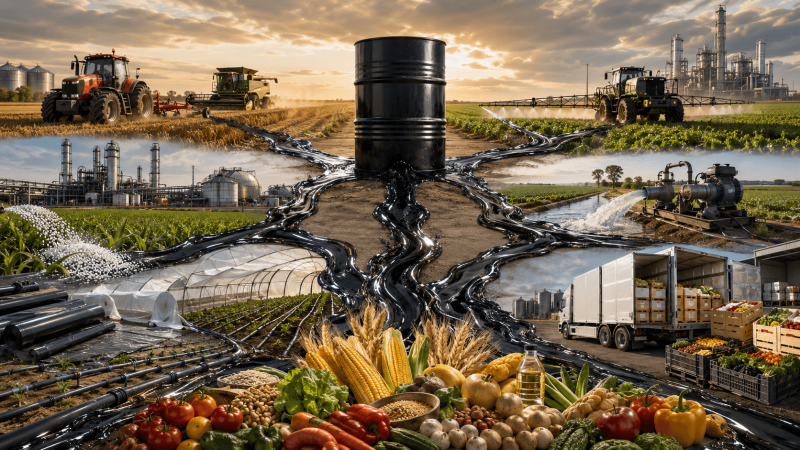
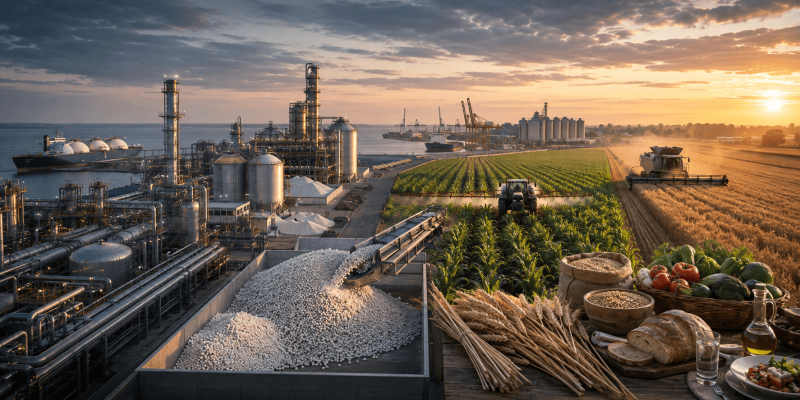
Natural gas → ammonia → nitrogen fertilizers → farming → crop yields → food supply → consumer prices.
When one part of this system is disrupted, the consequences can travel through several industries before reaching the final consumer. The process is rarely immediate and rarely caused by one factor alone, but it demonstrates what might be called the commodity domino effect.
Understanding that effect is essential for commodity traders, manufacturers, agricultural businesses and anyone trying to understand why events in energy markets can eventually influence something as ordinary as dinner.
Domino One: Natural Gas
The chain begins with natural gas.
Most people associate natural gas with electricity generation, heating and industrial energy. But natural gas also plays another critical role: it is both an energy source and an important feedstock for conventional ammonia production.
Ammonia is produced by combining hydrogen with nitrogen. In conventional natural-gas-based production, hydrogen is typically obtained from natural gas through processes such as steam methane reforming.
This makes ammonia production particularly sensitive to natural gas availability and pricing.
The International Energy Agency estimates that just over 70% of global ammonia production is based on natural gas. The ammonia industry consumes around 170 billion cubic metres of natural gas, demonstrating how closely the gas and fertilizer industries are connected.
When natural gas becomes expensive or difficult to obtain, the impact therefore extends beyond the energy market.
The first domino has fallen.
Domino Two: Ammonia Production
Ammonia is one of the most important chemical building blocks in global agriculture.
According to the International Energy Agency, approximately 70% of ammonia is used for fertilizer production. It describes ammonia as the starting point for all mineral nitrogen fertilizers — effectively forming a bridge between atmospheric nitrogen and the food produced by modern agriculture.
This connection is fundamental.
Plants require nitrogen for growth, but atmospheric nitrogen cannot simply be absorbed directly by most crops. Industrial ammonia production makes nitrogen available in forms that can eventually be supplied to agricultural systems.
Ammonia subsequently enters several fertilizer value chains and is particularly important for products such as urea and other nitrogen fertilizers.
That means disruption to ammonia production can quickly become a fertilizer-market problem.
Domino Three: Fertilizer
Now the disruption moves from the energy and chemical sectors into agriculture.
Urea is one of the world's most widely used nitrogen fertilizers, and its production depends on ammonia. The IEA notes that approximately half of ammonia production is converted into urea.
If natural gas prices rise substantially, ammonia producers face higher production costs. If gas itself becomes unavailable, some facilities may be forced to reduce operating rates or temporarily stop production.
This is not merely theoretical.
During previous energy crises, high natural gas prices contributed to ammonia and fertilizer production curtailments, particularly in regions where producers were heavily exposed to gas-market prices.
The relationship became highly visible again in 2026. The IEA reported that disruptions in Middle Eastern fertilizer exports combined with sharp increases in natural gas prices were affecting production rates for nitrogen fertilizers such as ammonia and urea in parts of Asia and Europe.
The commodity shock had already travelled from energy into fertilizers.
But Fertilizer Has Its Own Supply Chain
The story is even more interconnected than the simple natural-gas-to-urea pathway suggests.
Nitrogen fertilizers are only one part of modern crop nutrition. Agricultural systems also depend on phosphate and potash fertilizers, while sulphur plays an important role in several fertilizer and chemical value chains.
Products such as urea, ammonium sulphate, DAP, MAP, SSP, CAN and UAN serve different agricultural requirements and depend on different combinations of feedstocks, chemical processes and manufacturing infrastructure.
Each has its own exposure to energy costs, raw-material availability, production capacity, transportation and international trade.
A disruption does not therefore have to begin with natural gas.
It could begin with sulphur availability.
It could originate at an ammonia plant.
It could involve phosphate feedstocks.
It could arise from a port closure.
It could come from sanctions, export restrictions, shipping constraints or an interruption at a major maritime chokepoint.
Different starting points can eventually produce similar downstream pressure: fertilizer becomes more expensive or harder to obtain.
Domino Four: The Farmer
When fertilizer prices rise, the next participant facing the decision is the farmer.
Farmers do not have unlimited budgets.
Fertilizer competes with seeds, machinery, fuel, labour, irrigation, crop protection products, financing and other operating expenses. A significant increase in fertilizer prices therefore changes farm economics.
Farmers may respond in several ways.
Some absorb the additional cost.
Others change the fertilizer mix they use.
Some reduce application rates.
Others reduce the acreage planted with input-intensive crops or switch toward crops requiring different economics.
These responses depend on crop prices, soil conditions, government support, access to credit, local fertilizer availability and many other factors.
The important point is that an energy-market disruption has now become an agricultural decision.
The natural gas producer and the farmer may never interact directly, but their economics are connected through the commodity chain between them.
Domino Five: Crop Yields and Production
Fertilizers provide nutrients essential for crop development. If farmers cannot obtain the appropriate fertilizer at the right time or cannot afford economically viable application rates, agricultural productivity can come under pressure.
The effect is not necessarily immediate.
This is one of the most important characteristics of the commodity domino effect.
A natural gas disruption today does not mean food disappears from supermarket shelves tomorrow. Agriculture operates according to planting, fertilization and harvesting calendars.
A fertilizer shortage occurring before or during an important application period can influence a crop that will not be harvested for months.
That creates a time lag between the original commodity disruption and its potential impact on food supply.
The Food and Agriculture Organization has repeatedly highlighted this relationship. In 2026, FAO warned that disruptions affecting fertilizer availability could reduce future agricultural yields and tighten food supplies.
This is how a disruption that started upstream can quietly continue moving downstream long after the original event has disappeared from daily headlines.
Domino Six: Food Supply
Once agricultural production is affected, the next stage is the food supply chain.
Lower production of major crops can tighten available supply, although the final market effect depends on inventories, production in other countries, international trade and demand.
Grains illustrate the complexity particularly well.
Wheat can become flour and eventually bread and pasta.
Maize can enter human food products but is also widely used as animal feed and for industrial purposes.
Soybeans and other crops can enter food, vegetable-oil and livestock-feed chains.
Agricultural commodities therefore branch into multiple downstream markets.
A disruption affecting crop production can consequently influence more than one category of food.
The dominoes are no longer moving through a straight line. They are beginning to spread outward through an interconnected network.
From Grain to Meat and Dairy
The indirect effects can travel even further.
Livestock industries depend heavily on feed.
Poultry, cattle, dairy and other animal-production systems consume agricultural commodities as part of their feed requirements. If feed grains become significantly more expensive, livestock producers may experience higher production costs.
Those costs can eventually contribute to price pressure in meat, eggs and dairy products.
The original chain has therefore expanded:
Natural gas → ammonia → fertilizer → crops → animal feed → livestock production → food.
A consumer purchasing chicken or milk may be several stages removed from the natural gas market, but commodity economics can still connect the two.
Energy Hits Agriculture Twice
There is another reason energy disruptions can have an unusually broad effect on food.
Energy does not influence agriculture only through fertilizer.
Modern farming itself requires energy.
Diesel powers tractors, harvesters and agricultural machinery. Electricity can operate irrigation systems, storage facilities and processing equipment. Agricultural products must then be transported from farms to processors, warehouses, ports, distribution centres and retailers.
Food processing consumes additional energy.
Refrigeration consumes energy.
Packaging requires materials and manufacturing.
Transportation requires fuel.
Consequently, a major energy-price shock can affect the food system through multiple channels simultaneously.
One channel runs through fertilizer.
Another runs through farm operations.
Another through processing.
Another through logistics.
This is why energy markets occupy such an important position within the broader commodity system.
Logistics Can Become Another Domino
Even when sufficient commodities exist globally, they still need to reach the correct market.
A fertilizer plant can operate normally while buyers thousands of kilometres away experience shortages because transportation has been disrupted.
Commodity flows depend on ports, vessels, terminals, pipelines, warehouses, rail networks and road transportation.
Certain maritime routes are particularly important because enormous volumes of energy and agricultural commodities pass through relatively narrow geographic corridors.
The importance of these chokepoints became especially visible in 2026, when disruptions around the Strait of Hormuz affected energy and fertilizer trade.
FAO reported that the Strait normally carries significant shares of internationally traded crude oil, LNG and fertilizer products. Disruption therefore created pressure across several commodity markets simultaneously.
This is a perfect illustration of the domino effect: one geographic disruption can influence energy availability, fertilizer supply and agricultural economics at the same time.
The 2026 Example: When the Chain Became Visible
The commodity domino effect is not simply an economic thought experiment.
Recent events have provided a particularly clear example.
During 2026, disruptions in the Middle East affected both energy and fertilizer markets. Reduced fertilizer exports from the Gulf coincided with higher natural gas prices and tighter LNG availability.
The consequences spread rapidly.
The International Energy Agency reported that higher gas prices were weighing on nitrogen-fertilizer production in parts of Europe and Asia, while reduced LNG availability affected fertilizer production in several Asian markets.
The World Bank reported significant increases in fertilizer prices during the first quarter of 2026, driven particularly by urea, supply disruptions and higher input costs.
FAO subsequently warned that fertilizer scarcity could affect upcoming harvests and tighten food supplies later in 2026 and into 2027.
This demonstrates the delayed nature of commodity shocks.
The disruption occurs first.
Energy markets react.
Industrial production responds.
Fertilizer availability changes.
Farmers make planting and input decisions.
Crops grow.
Harvests arrive months later.
Only then can the full consequences for food availability become apparent.
Why Commodity Prices Move Before Physical Shortages Appear
Markets do not always wait for an actual shortage.
Commodity prices are forward-looking.
If traders, manufacturers or buyers believe future supply may become constrained, they may begin securing material earlier than usual.
Importers may build inventories.
Governments may increase strategic purchases.
Companies may seek alternative suppliers.
Exporting countries may introduce restrictions to protect domestic supply.
Shipping rates may increase as companies search for alternative routes.
These responses can amplify price movements even before physical inventories become critically low.
This explains why commodity markets sometimes react sharply to geopolitical events that have not yet caused obvious shortages for consumers.
Markets are pricing not only today's physical supply, but also expectations about tomorrow.
Why Diversified Supply Matters
The domino effect also explains why supply-chain diversification matters.
Companies that depend entirely on a single producer, country, port or transportation route are more exposed when disruptions occur.
Diversification cannot eliminate global commodity risk, but it can reduce dependence on a single point of failure.
For industrial buyers, this can involve developing relationships with suppliers across multiple origins, monitoring inventory levels, understanding alternative product specifications and planning logistics before shortages become severe.
For traders, the ability to connect alternative sources with changing demand becomes particularly important during periods of disruption.
Commodity trading is therefore not simply about finding the lowest price.
It is also about managing continuity of supply.
Where Prime Petrochem Fits Into the Chain
The commodity domino effect explains why the different product categories traded by Prime Petrochem are more interconnected than they may initially appear.
Natural gas and energy markets influence petrochemical and fertilizer economics.
Ammonia connects energy with nitrogen fertilizers.
Sulphur connects energy processing with chemical and fertilizer production.
Products such as urea, ammonium sulphate, DAP, MAP, SSP, CAN and UAN support different segments of global agriculture.
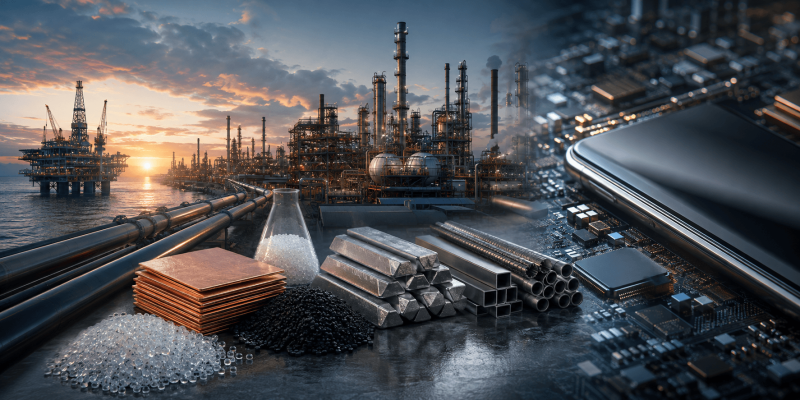
Petrochemicals and polymers feed manufacturing and packaging industries.
Metals and steel products support the plants, transportation networks, storage facilities and infrastructure through which these commodities move.
Prime Petrochem operates across several points within this wider industrial network, connecting producers and buyers across energy products, petrochemicals, fertilizers, metals and other industrial commodities.
Understanding those relationships matters because a development in one market can quickly create opportunities, constraints or risks in another.
Commodities Do Not Exist in Isolation
We often talk about natural gas, fertilizers, metals, petrochemicals and agricultural products as separate markets.
Commercially, they are separate commodities.
Economically, however, they belong to a deeply connected system.
Natural gas can become ammonia.
Ammonia becomes fertilizer.
Fertilizer supports crops.
Crops become food and animal feed.
Feed supports livestock production.
Energy moves tractors, factories and trucks.
Steel builds the facilities.
Petrochemicals become packaging and industrial materials.
Ships and ports connect producers with consumers across continents.
The final product on a supermarket shelf is therefore the visible end of an enormous industrial network most consumers never see.
The Dinner Table Is Closer to the Commodity Market Than It Looks
When energy markets experience a major disruption, the immediate headlines usually focus on oil prices, natural gas prices or transportation costs.
But the final consequences can travel much further.
A disruption in natural gas can influence ammonia production. Reduced or more expensive ammonia can affect fertilizer markets. Higher fertilizer costs can change farmers' decisions. Those decisions can influence future harvests. Changes in agricultural supply can affect processors, livestock producers and ultimately food markets.
Not every disruption completes the entire chain, and many other factors — weather, inventories, trade policy, exchange rates and consumer demand among them — influence the final outcome.
But the connection exists.
That is the real lesson of the commodity domino effect.
In the global economy, an event does not have to happen near you to affect you.
Sometimes the journey from a natural gas field to the dinner table is only a few dominoes long.