The Barrel Behind Everything: How Oil Becomes the Materials Around Us
Explore the journey from crude oil to petrochemicals and discover how oil-derived feedstocks become plastics, synthetic rubber, fibers, chemicals and essential materials used across global industries.
From Crude Oil to Everyday Materials: What Petrochemical Products Are Made from Oil?
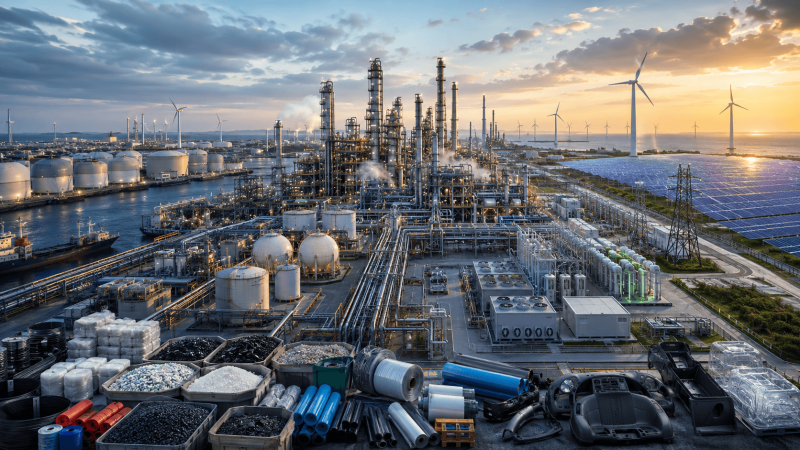
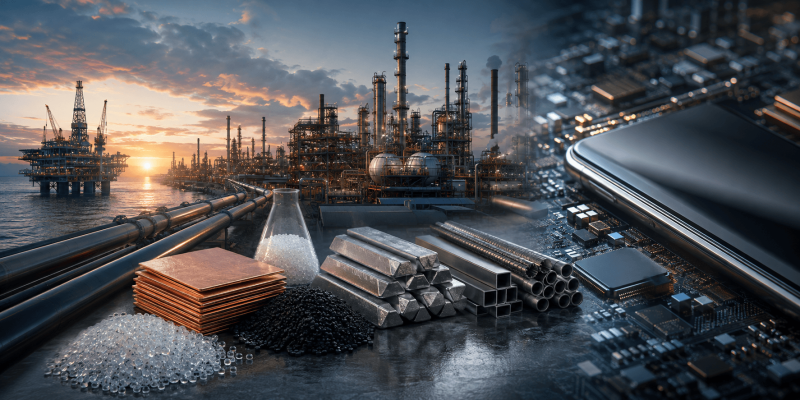
Crude oil is usually associated with gasoline, diesel and jet fuel. Yet transportation fuels represent only one part of what the petroleum value chain provides. Oil is also an important source of chemical feedstocks that ultimately become plastics, synthetic rubber, fibers, solvents, coatings, detergents and thousands of industrial and consumer products.
The transformation is not as simple as turning crude oil directly into plastic. Instead, crude oil passes through a complex chain of refining, separation, conversion and petrochemical processing. Along the way, hydrocarbon fractions are converted into basic petrochemicals, intermediates and eventually the materials used by manufacturers around the world.
Understanding this chain helps explain why crude oil remains closely connected not only to the energy market, but also to global manufacturing.
The First Step: Refining Crude Oil
Crude oil is not a single substance. It is a complex mixture of hydrocarbons with different molecular structures and boiling points.
At a refinery, crude oil first undergoes separation, primarily through distillation. Different hydrocarbon fractions are separated and subsequently converted or treated according to their intended use.
Some refinery streams become transportation fuels and other petroleum products. Others become valuable petrochemical feedstocks.
One of the most important oil-derived petrochemical feedstocks is naphtha. Naphtha can be sent to petrochemical facilities rather than being used solely in fuel production. Through further processing, its hydrocarbons can be transformed into some of the fundamental building blocks of the chemical industry.
Naphtha: A Major Bridge Between Oil and Petrochemicals
Naphtha occupies an important position between petroleum refining and petrochemical manufacturing.
In a steam cracker, naphtha can be exposed to high temperatures to break larger hydrocarbon molecules into smaller and more commercially useful molecules. This process produces important olefins, including:
- Ethylene
- Propylene
- Butadiene
The exact product yield depends on the feedstock and operating conditions.
These basic petrochemicals may appear far removed from finished consumer products, but they sit near the beginning of enormous global manufacturing chains.
Ethylene: One of the Most Important Petrochemical Building Blocks
Ethylene is among the most important basic petrochemicals produced by the industry.
One of its largest downstream applications is the manufacture of polyethylene (PE). Different production technologies create several major polyethylene families, including:
HDPE – High-Density Polyethylene
HDPE is widely used for rigid containers, bottles, industrial packaging, pipes and numerous molded products.
LDPE – Low-Density Polyethylene
LDPE is commonly used in films, flexible packaging, bags, coatings and other applications requiring flexibility.
LLDPE – Linear Low-Density Polyethylene
LLDPE is particularly important in packaging films, stretch films, agricultural films and flexible plastic applications.
But polyethylene is only one branch of the ethylene value chain. Ethylene can also be processed into intermediates used to manufacture products such as PVC, ethylene glycol, PET-related materials, detergents, solvents and other chemicals.
A single basic petrochemical therefore branches into multiple downstream industries.
Propylene: The Foundation of Polypropylene and More
Another major petrochemical building block is propylene.
Its best-known downstream product is polypropylene (PP), one of the world's most widely used thermoplastics.
Polypropylene combines relatively low weight with chemical resistance and useful mechanical properties. It is found across:
- Automotive components
- Food packaging
- Household products
- Fibers and nonwoven materials
- Industrial packaging
- Medical applications
- Consumer goods
- Pipes and molded components
Propylene is also used as a starting material for other chemicals and intermediates, expanding its importance far beyond polypropylene alone.
Butadiene and the Synthetic Rubber Industry
Butadiene provides another example of how petroleum-derived feedstocks reach products that consumers rarely associate with crude oil.
It is an important raw material for the manufacture of several types of synthetic rubber and elastomers.
These materials are used extensively in tires, automotive components, hoses, footwear, industrial rubber goods and other applications requiring elasticity and durability.
The connection can therefore run:
Oil-derived feedstock → Butadiene → Synthetic rubber → Tire
This illustrates how developments in petroleum and petrochemical feedstock markets can eventually affect industries far downstream from the original barrel of crude.
Aromatics: Benzene, Toluene and Xylenes
Oil refining and petrochemical processing also provide another major family of chemical building blocks known as aromatics.
Three particularly important examples are:
Benzene – used as a feedstock for numerous chemicals that ultimately enter plastics, resins, synthetic fibers, detergents and other manufactured materials.
Toluene – used in chemical manufacturing and as a component or feedstock for solvents, coatings and other industrial products.
Xylenes – particularly important in chemical manufacturing. Para-xylene, for example, is a major feedstock in the value chain leading to polyester and PET materials.
Together, benzene, toluene and xylenes are commonly referred to as BTX aromatics and form another major pillar of the petrochemical industry.
From Basic Chemicals to Plastics
One of the clearest ways to understand the petrochemical chain is to follow the material from the refinery to the finished product.
A simplified polyethylene chain may look like:
Crude Oil → Naphtha → Ethylene → Polyethylene → Finished Plastic Product
For polypropylene:
Crude Oil / Refinery Feedstocks → Propylene → Polypropylene → Finished Product
For polyester-related materials:
Oil-Derived Aromatics → Para-Xylene → Chemical Intermediates → Polyester/PET → Fibers or Packaging
Each step represents a separate industrial market involving producers, processors, traders, logistics companies and manufacturers.
Petrochemicals Are Much More Than Plastic
Plastics are highly visible petrochemical products, but focusing exclusively on plastic significantly understates the industry's reach.
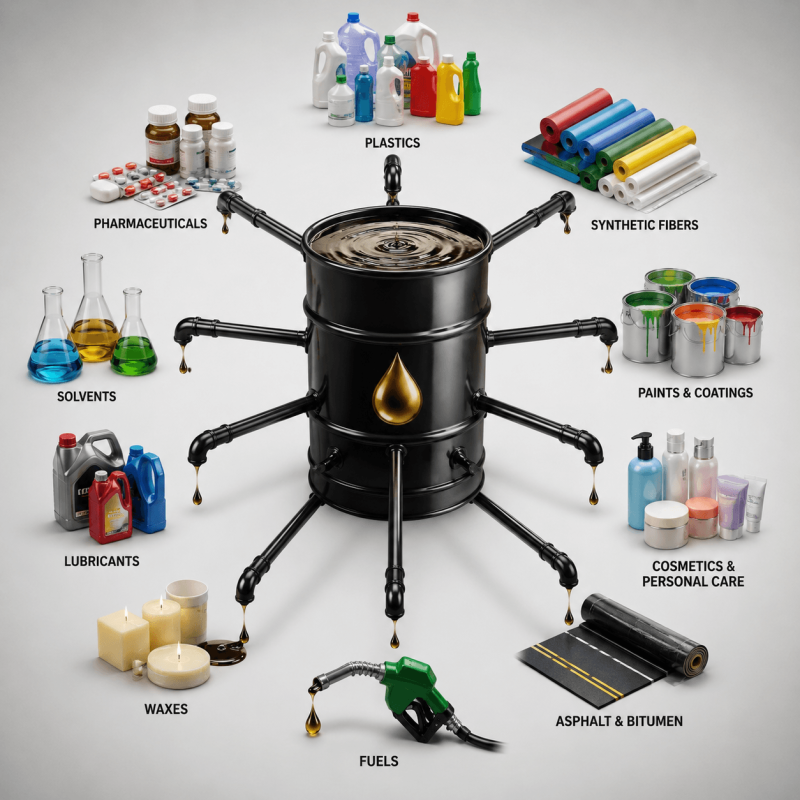
Petroleum-derived chemical building blocks and intermediates contribute to the manufacture of synthetic fibers, synthetic rubber, paints and coatings, adhesives, detergents, solvents, insulation, packaging materials, automotive components, construction materials, electrical components and countless specialty chemicals.
A modern car, building, smartphone, refrigerator, pair of running shoes or package of food can contain materials whose chemical value chains ultimately connect back to petroleum or natural gas feedstocks.
That is why petrochemicals occupy a unique position between the energy sector and manufacturing economy.
What About Bitumen, Base Oil and Petroleum Coke?
There is an important terminology distinction.
Products such as bitumen, base oils, lubricants and petroleum coke can also originate from crude-oil refining. However, they are more accurately described as petroleum or refinery products rather than basic petrochemicals such as ethylene, propylene or benzene.
For example, heavier refinery fractions can ultimately contribute to bitumen production, while specific refinery processes produce petroleum coke. Lubricating base stocks undergo dedicated refining processes to produce base oils.
They all originate within the broader petroleum value chain, but their manufacturing pathways and end markets differ from those of conventional petrochemicals.
One Barrel, Multiple Industrial Value Chains
The economic importance of crude oil extends considerably beyond combustion.
A portion of the petroleum value chain supplies fuels. Another provides materials and chemical feedstocks that move into petrochemical plants and then through multiple stages of industrial transformation.
The chain can extend from:
Crude Oil → Refinery → Petrochemical Feedstock → Basic Chemical → Intermediate → Industrial Material → Finished Product
This is why changes in crude oil availability, refinery operations, naphtha markets, petrochemical capacity or international shipping can have consequences far beyond fuel prices.
They can influence the cost and availability of polymers, packaging, construction materials, automotive components, synthetic textiles and other manufactured goods traded globally.
The Industrial World Behind a Barrel of Oil
Crude oil should not be viewed simply as a source of energy. It is also a source of molecular building blocks for modern manufacturing.
From ethylene, propylene and aromatics to polyethylene, polypropylene, synthetic rubber and polyester-related materials, the petrochemical value chain transforms hydrocarbons into materials that surround us every day.
For international commodity markets, understanding these connections is increasingly important. Petrochemical supply is influenced not only by demand for individual products but also by upstream feedstock availability, refinery economics, production capacity, logistics and downstream manufacturing demand.
At Prime Petrochem, we operate across this interconnected commodity landscape, supplying petrochemical products and industrial raw materials to customers across international markets. By connecting reliable producers with global buyers, we support the movement of essential materials through the industrial value chains that keep modern manufacturing operating.