Commodity Exchanges Explained: How Global Markets Determine Prices and Influence International Trade
Discover how commodity exchanges work, how global benchmarks influence petrochemical, fertilizer and metal prices, and what international buyers should know before evaluating quotations.
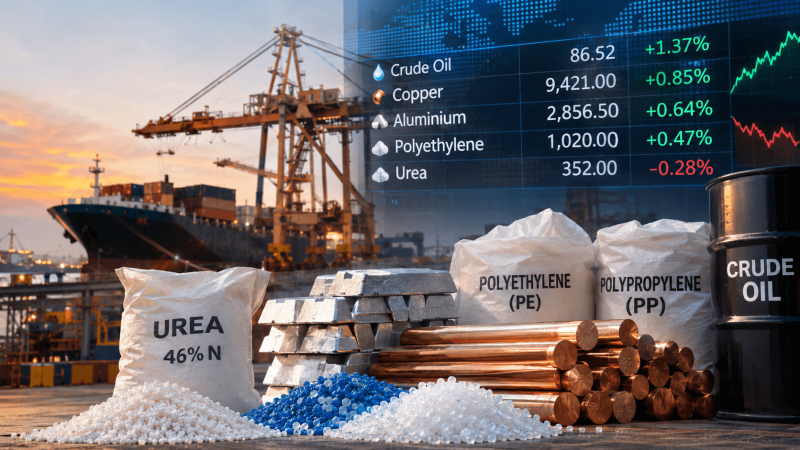
Why can the price of copper change several times in a single day? Why might a polyethylene supplier revise a quotation even when its production costs remain unchanged? And how do international traders determine whether a commodity price is competitive?
The answers often begin with commodity exchanges, international price benchmarks, and the mechanisms connecting global markets with physical trade.
Every day, billions of dollars' worth of commodities are bought, sold, priced, or hedged through international markets. From crude oil and petrochemicals to fertilizers and industrial metals, changes in market prices influence manufacturers, suppliers, distributors, and international trading companies.
Yet one of the most important distinctions in commodity trading is frequently misunderstood: the price displayed on an exchange is not necessarily the price a buyer will pay for a physical shipment.
Understanding how commodity exchanges operate, how their prices are established, and how these benchmarks influence commercial quotations is essential for navigating international commodity markets.
What Is a Commodity Exchange?
A commodity exchange is an organized marketplace where standardized contracts involving raw materials and primary products are traded.
Unlike conventional wholesale markets, where buyers and sellers negotiate directly for physical goods, modern commodity exchanges primarily facilitate trading in standardized futures and options contracts.
These contracts establish specific conditions concerning the underlying commodity, quantity, quality, pricing, settlement, and delivery period.
For example, instead of negotiating an individual shipment of copper with a producer, a market participant can trade a standardized copper futures contract whose value reflects changing market expectations.
Commodity exchanges perform three essential functions:
-
Price discovery: Establishing publicly observable prices through interaction between buyers and sellers.
-
Risk management: Allowing businesses to reduce exposure to adverse commodity price movements.
-
Market transparency: Providing reference prices that can inform physical commodity transactions worldwide.
Not every commodity is traded directly on an exchange, and not every exchange-traded contract results in physical delivery.
Nevertheless, the prices discovered in these markets can influence transactions far beyond the exchanges themselves.
The World's Major Commodity Exchanges
Several international exchanges play particularly important roles in the pricing of energy products, metals, agricultural commodities, and industrial raw materials.
London Metal Exchange (LME)
The London Metal Exchange is one of the most important international pricing venues for industrial metals.
Its markets cover commodities including copper, aluminium, zinc, nickel, lead, and tin.
LME reference prices are widely used by producers, manufacturers, distributors, and trading companies when negotiating physical metal contracts.
For example, an international transaction involving copper cathodes may use an agreed LME copper reference price, adjusted by a premium or discount reflecting the material's quality, origin, and delivery conditions.
The exchange therefore provides a common starting point for negotiations between businesses operating in different countries.
CME Group
CME Group operates major derivatives markets covering energy, agricultural commodities, metals, and financial instruments.
Its commodity markets include crude oil, natural gas, copper, agricultural products, and selected fertilizer contracts.
The Chicago Mercantile Exchange (CME), Chicago Board of Trade (CBOT), and New York Mercantile Exchange (NYMEX) are among the exchanges associated with CME Group.
For industrial commodity traders, CME markets can provide useful information about expected price movements, supply conditions, and hedging opportunities.
Intercontinental Exchange (ICE)
The Intercontinental Exchange operates major energy and commodity derivatives markets.
One of its most significant products is Brent crude oil futures, an internationally recognized benchmark for oil pricing.
Brent prices are closely monitored by businesses involved in refining, energy, petrochemicals, transportation, and industrial manufacturing.
Although Brent is a crude oil benchmark rather than a direct quotation for polyethylene or polypropylene, changes in energy markets can influence petrochemical production costs and broader market expectations.
This relationship is especially relevant where petrochemical production depends on oil-derived feedstocks such as naphtha.
Regional and Specialized Commodity Markets
Beyond these major exchanges, various regional markets and specialized trading platforms serve particular commodities and geographic areas.
These markets are important because global commodity trade is not governed by one universal price.
A commodity's value can differ considerably depending on where it is produced, where it will be consumed, the applicable product specifications, and the available transportation infrastructure.
How Does a Commodity Exchange Actually Work?
To understand how exchanges influence international trading, consider a simplified example involving copper.
Suppose a manufacturer expects to require 100 metric tonnes of copper in three months.
The manufacturer is concerned that copper prices may increase before the purchase takes place.
Rather than simply accepting this uncertainty, the company may use an appropriate futures contract to manage its price exposure.
The process generally involves several stages.
Step 1: Selecting the Commodity and Contract
The participant first identifies the appropriate exchange-traded contract.
For copper, this may involve an LME copper contract or another suitable copper derivative.
Each contract has defined specifications, including its contract size, delivery or settlement dates, quotation currency, and settlement method.
The company must ensure that the selected contract closely corresponds to its physical exposure.
Step 2: Understanding the Market Price
The company examines the applicable contract price.
Assume that an appropriate copper futures contract is trading at USD 9,000 per metric tonne.
This figure is purely illustrative and is not a current market quotation.
The company can use the price as a reference when estimating future procurement costs.
However, the exchange price may exclude physical delivery premiums, transportation, insurance, import charges, and other expenses.
Step 3: Placing a Trade
To trade futures, participants generally access the exchange through an authorized broker, clearing member, or trading intermediary.
A company seeking protection against rising purchase costs may establish a long futures position.
This means it purchases futures contracts whose value would generally increase if the relevant futures price rises.
A producer concerned about falling selling prices may take the opposite position by selling futures.
Step 4: Managing Margin and Market Movements
Futures trading commonly requires collateral known as margin.
Initial margin provides security when a position is opened, while variation margin reflects subsequent changes in the position's market value.
This introduces an important consideration.
Even when a hedge is economically appropriate, adverse short-term futures movements can create significant cash-flow requirements.
Companies therefore need appropriate liquidity, internal controls, and risk-management procedures.
Step 5: Closing or Settling the Contract
Depending on the contract, settlement may involve cash settlement, physical delivery, or closing the position before its delivery period.
Many commercial hedgers close their financial positions and separately purchase or sell the physical commodity.
The financial gain or loss on the futures position then helps offset changes in the underlying physical price.
The objective is not necessarily to generate a trading profit. It is to achieve greater predictability in commercial costs or revenues.
How Are Commodity Prices Determined?
Commodity prices are primarily shaped by the interaction of supply and demand, but the process involves numerous interconnected factors.
Supply and production capacity
Production outages, refinery maintenance, mining disruptions, plant closures, and new manufacturing capacity can influence commodity availability.
When supply becomes constrained relative to demand, prices may increase.
Conversely, substantial new production capacity can create oversupply and downward pressure on prices.
Industrial and consumer demand
Demand for commodities ultimately depends on the industries consuming them.
Construction activity influences steel and copper consumption. Packaging manufacturers purchase polyethylene and polypropylene. Agricultural production drives demand for fertilizers.
Changes in downstream industrial activity therefore affect commodity purchasing decisions.
Energy and feedstock costs
Energy is an important production input across numerous commodity industries.
Crude oil, natural gas, naphtha, and other feedstocks can influence petrochemical and fertilizer production economics.
However, the relationship is not always direct.
A reduction in crude oil prices does not guarantee an immediate decline in polymer prices, particularly when local supply shortages or strong demand support the market.
Geopolitical developments
Sanctions, tariffs, export restrictions, geopolitical tensions, and changes in trade policy can disrupt international commodity flows.
Even when global production remains relatively stable, changes in trade routes can affect regional availability and pricing.
Transportation and logistics
Shipping costs, port congestion, vessel availability, insurance, and inland transportation expenses all influence the final cost of delivered commodities.
A commodity may be inexpensive at its origin but considerably more expensive when delivered to another market.
Currency movements
Many international commodity benchmarks and transactions are denominated in US dollars.
Exchange-rate changes can therefore affect purchasing costs for businesses operating in other currencies.
How Commodity Exchanges Influence Supplier Quotations
This is where commodity exchanges become particularly important for international trading companies.
A supplier's quotation is generally determined by more than the headline market price.
It may incorporate an exchange benchmark, a regional price assessment, product specifications, commercial margins, and delivery-related expenses.
A simplified pricing relationship is:
Final quotation = Relevant reference price + Product premium or discount + Applicable logistics and commercial costs
The precise calculation depends on the agreed Incoterms rule, contractual responsibilities, and whether particular expenses are already included in the selected reference price.
Let us examine three examples involving products traded by Prime Petrochem.
Example 1: Copper Cathodes and the LME
Suppose a buyer requests 100 metric tonnes of copper cathodes.
For illustration, assume the parties agree to use an LME copper reference price of USD 9,000 per metric tonne.
The supplier applies a USD 150 per tonne premium to reflect agreed product and commercial conditions.
The resulting illustrative price would be:
| Pricing component | USD/MT |
|---|---|
| LME reference price | 9,000 |
| Agreed premium | +150 |
| Calculated price | 9,150 |
The total would equal USD 915,000 for 100 metric tonnes, before any additional costs not already covered by the agreed terms.
Now assume that the applicable LME reference price increases to USD 9,300 per tonne while the premium remains unchanged.
The calculated price becomes USD 9,450 per tonne.
That represents an increase of USD 30,000 across the same 100-tonne order.
This demonstrates why a supplier may revise its quotation even though the product's quality, quantity, and origin remain unchanged.
The key point: An LME-based quotation is only fully understood when the reference contract, pricing date or averaging period, premium, and delivery terms are specified.
Example 2: Polyethylene and Polypropylene Pricing
Petrochemical polymers operate differently from exchange-traded industrial metals.
Products such as high-density polyethylene (HDPE), low-density polyethylene (LDPE), linear low-density polyethylene (LLDPE), and polypropylene (PP) are not normally priced through one universal, highly liquid exchange benchmark comparable to LME copper.
Instead, international polymer trading frequently relies on regional market assessments, supplier offers, reported transactions, and negotiated commercial terms.
Independent price reporting agencies, including ICIS and S&P Global Commodity Insights, monitor petrochemical markets and publish assessments for defined products, locations, and delivery conditions.
Consider an illustrative HDPE quotation.
A supplier identifies a relevant regional HDPE price assessment of USD 950 per metric tonne.
After examining the required grade, product availability, delivery location, and commercial conditions, the supplier offers USD 1,020 per tonne on the agreed basis.
The difference may reflect logistics, product-specific premiums, supplier margins, or other contractual costs.
However, another supplier may offer the same general product category at a different price because the available grade, origin, shipment date, or delivery terms differ.
This is why the expression “What is the price of polyethylene today?” is commercially incomplete.
The appropriate questions are:
-
Which polyethylene grade is required?
-
What is the specified melt flow index, density, or other relevant technical characteristic?
-
Which country or region is the material being sourced from?
-
What quantity is required?
-
What is the destination?
-
Which delivery terms apply?
-
What shipment period is requested?
Without these details, a quoted number may offer little basis for a meaningful comparison.
Example 3: Urea and International Fertilizer Markets
Fertilizer markets provide another useful example.
Granular urea is traded internationally, and some regional urea markets have corresponding futures contracts.
CME Group has listed fertilizer futures referencing markets such as the US Gulf, Egypt, the Middle East, and Brazil.
However, a urea quotation can differ significantly depending on the region and commercial terms.
Consider two hypothetical offers:
-
Supplier A offers granular urea at USD 350 per tonne FOB at the loading port.
-
Supplier B offers granular urea at USD 390 per tonne CFR at the destination port.
At first glance, Supplier A appears cheaper.
But these offers are not directly comparable.
Under FOB terms, the buyer generally arranges and pays for the main ocean carriage. Under CFR, the seller pays for carriage to the named destination port, although risk transfers when the goods are loaded on board at the port of shipment.
If the buyer would incur USD 50 per tonne in freight to transport Supplier A's product, the combined product-and-freight cost becomes USD 400 per tonne, before other applicable costs.
Under those assumptions, Supplier B's USD 390 CFR quotation may be economically more attractive.
A lower commodity price does not necessarily mean a lower delivered procurement cost.
What Is the Difference Between Spot Prices, Futures Prices, and Market Assessments?
These three concepts are central to understanding international commodity quotations.
Spot Price
A spot price refers to the price of a commodity for prompt purchase and delivery under specified market conditions.
In practice, physical spot transactions still require agreement on location, product specifications, payment, and delivery timing.
Futures Price
A futures price refers to the market price of a standardized contract associated with a future settlement or delivery period.
Futures prices reflect market expectations as well as factors such as financing, storage, and supply conditions.
They are not guaranteed forecasts of future physical prices.
Price Assessment
A price assessment is an independently published evaluation of the market value of a defined commodity under specified conditions.
Price reporting agencies may consider reported transactions, bids, offers, and other relevant market evidence under their published methodologies.
Such assessments are especially important in markets where substantial physical trading occurs through direct negotiations rather than centralized exchanges.
For petrochemical trading, price assessments can be just as commercially important as exchange quotations.
Why Is the Same Commodity Priced Differently Across Countries?
A frequent misunderstanding is that commodities should have one global price because they are internationally traded.
In reality, even standardized commodities can have substantial regional price differences.
Consider polyethylene.
A producer in the Middle East may have access to competitive feedstocks, while a producer in another region faces different energy costs, manufacturing expenses, and local market conditions.
At the same time, transportation costs and import duties influence the price paid by overseas buyers.
A surplus of polymer supply in one region may lead to attractive export offers, while buyers in another market face relatively high prices because of limited availability or expensive logistics.
The same principle applies to copper, aluminium, methanol, sulphur, and fertilizers.
Consequently, international traders monitor not just absolute commodity prices but also regional price differentials.
These differences can create commercial opportunities for suppliers capable of sourcing from one market and delivering competitively to another.
However, regional price differences do not automatically represent profitable arbitrage. Freight, quality restrictions, taxes, financing, delivery risks, and available volumes must also be considered.
How to Read a Commodity Quotation Correctly
A commercial quotation should be understood as a complete set of contractual conditions, not simply a price per tonne.
For example:
Product: HDPE Injection Grade
Quantity: 500 metric tonnes
Unit Price: USD 1,050/MT
Delivery Term: CFR Jebel Ali, UAE, Incoterms® 2020
Shipment: December 2026
Payment: As agreed between buyer and seller
Quotation Validity: 48 hours
This is an illustrative example, not a live Prime Petrochem offer.
Each element matters.
Product specification: Determines whether the material is suitable for the buyer's intended application.
Quantity: Influences production allocation, handling, freight economics, and commercial pricing.
Unit price: Establishes the basic cost per metric tonne.
Delivery term: Defines important responsibilities involving transportation, cost allocation, and the transfer of risk.
Shipment period: Determines when the seller is expected to dispatch the cargo and can influence pricing when market availability changes.
Payment terms: Affect financing requirements and counterparty exposure.
Validity period: Establishes how long the offer remains open for acceptance, subject to its contractual wording.
A quotation lacking these details may be difficult to evaluate and can create avoidable misunderstandings.
FOB, CFR, and CIF: Why Delivery Terms Affect Commodity Prices
International commodity trading frequently uses Incoterms® rules developed by the International Chamber of Commerce.
Three commonly encountered terms in bulk commodity shipping are FOB, CFR, and CIF.
| Term | Main freight responsibility | Insurance obligation |
|---|---|---|
| FOB — Free on Board | Buyer arranges and pays for main carriage | No general obligation to procure insurance |
| CFR — Cost and Freight | Seller pays freight to the named destination port | Seller is not required to procure insurance |
| CIF — Cost, Insurance and Freight | Seller pays freight to the named destination port | Seller must obtain the required cargo insurance |
Under all three rules, risk generally transfers to the buyer when the goods are loaded on board the vessel at the shipment port, even though the seller pays for destination freight under CFR and CIF.
These rules are intended for sea and inland waterway transport, and the appropriate Incoterms rule must be selected for the shipment.
When comparing quotations, buyers should ensure that they are evaluating equivalent delivery conditions.
Comparing an FOB price with a CIF price without considering freight and insurance can lead to incorrect procurement decisions.
Fixed-Price vs. Formula-Based Commodity Quotations
Another important commercial distinction concerns how the final selling price is established.
Fixed-Price Quotation
Under a fixed-price arrangement, the parties agree on a specified price for the contracted quantity, subject to the terms of the agreement.
For example:
Copper cathodes: USD 9,200 per metric tonne
This approach provides price certainty for the transaction.
However, the supplier or buyer may still face market exposure if their corresponding purchase or sale has not been secured at an economically compatible price.
Formula-Based Quotation
Under a formula-based arrangement, the price is calculated using an agreed market reference.
For example:
Copper cathodes = Average LME Official Cash Seller & Settlement Price during the agreed pricing period + USD 150/MT
The contractual language must specify the exact reference, period, currency, and premium.
If the benchmark increases, the resulting sales price increases. If it decreases, the price generally declines according to the formula.
This structure allows commercial prices to adjust alongside the market.
Formula pricing is especially useful in long-term commodity relationships, where fixing a single price for extended periods may create excessive exposure for one or both parties.
However, it is essential to agree on how the benchmark will be calculated and what happens if the benchmark becomes unavailable or its methodology changes.
How Commodity Traders Use Market Information
Commodity exchanges and price assessments are not relevant only to financial traders.
They also provide essential commercial intelligence for companies buying and selling physical industrial products.
A disciplined trading process generally involves the following steps.
1. Identify the Relevant Market
Determine which international exchange, regional assessment, or supplier market is relevant to the product.
Copper may be evaluated using LME references, while polyethylene often requires regional polymer price assessments.
2. Monitor Market Direction
Review current prices and historical trends alongside supply, demand, operating rates, shipping conditions, and relevant economic developments.
Avoid assuming that a recent price movement will necessarily continue.
3. Compare Equivalent Specifications
Make sure competing quotations refer to materially equivalent products.
For polypropylene, for example, injection grade and raffia grade should not automatically be treated as interchangeable.
For industrial metals, purity, form, brand, and delivery location can affect value.
4. Calculate the Full Delivered Cost
Include all applicable costs not already covered by the quotation.
These may include ocean freight, insurance, customs duties, inland transportation, handling, financing, and inspection.
5. Evaluate Timing and Price Exposure
Consider whether the quotation is fixed or linked to a benchmark.
Determine what happens if market prices change between the initial offer, contract signing, shipment, and final payment.
6. Assess Supplier and Counterparty Reliability
Competitive pricing alone is insufficient.
Buyers should evaluate commercial documentation, supply capability, technical specifications, payment security, and the likelihood of timely delivery.
7. Establish a Clear Contract
The purchase agreement should identify the product, quantity, quality, applicable standards, price mechanism, shipment conditions, required documents, payment terms, and dispute-resolution arrangements.
Where benchmark pricing applies, the pricing formula and reference source should be unambiguous.
Can Businesses Protect Themselves Against Commodity Price Volatility?
Yes. Some businesses use hedging strategies to reduce the impact of unfavorable price movements.
For example, a manufacturer planning to purchase aluminium in several months may use appropriate derivatives to offset some of the risk of increasing prices.
Similarly, a producer concerned about falling selling prices may hedge part of its anticipated output.
However, hedging is not equivalent to eliminating all commercial risk.
Even where the futures price is effectively hedged, the delivered physical price can still change because of regional premiums, transportation expenses, currency movements, or differences between the financial contract and the physical product.
This remaining exposure is often described as basis risk.
Hedging also involves transaction costs, margin requirements, counterparty arrangements, and operational complexity.
For companies unfamiliar with derivative markets, professional risk-management advice and clearly defined internal policies are important before entering exchange-traded positions.
A more straightforward form of commercial risk management may involve back-to-back purchasing and selling arrangements, matching supply commitments with confirmed customer contracts, or aligning price-fixing periods between purchases and sales.
The appropriate approach depends on the company's exposure, liquidity, commercial objectives, and risk tolerance.
How Commodity Markets Influence Prime Petrochem's Product Categories
The relationship between commodity markets and physical trading differs across product groups.
Understanding these differences is especially important for suppliers operating across petrochemicals, fertilizers, metals, and industrial infrastructure products.
| Product category | Examples | Relevant pricing considerations |
|---|---|---|
| Petrochemicals | Polyethylene, polypropylene, PVC, methanol | Regional price assessments, feedstock costs, supply and demand, grade specifications |
| Fertilizers and related materials | Urea, ammonium nitrate, ammonium sulphate, sulphur | Regional trade benchmarks, energy costs, agricultural demand, freight, availability |
| Non-ferrous metals | Copper cathodes, aluminium ingots | LME reference prices, premiums, quality, delivery terms |
| Ferrous materials | Steel billets, steel slabs, pig iron | Regional steel prices, input costs, market assessments, grade and logistics |
| Industrial and infrastructure products | Steel pipes, HDPE pipes, valves and fittings | Underlying raw-material costs, manufacturing specifications, fabrication, project requirements |
For petrochemical products, market analysis often involves evaluating both upstream feedstock developments and downstream industrial demand.
For metals, exchange prices can provide a relatively direct commercial reference, particularly for standard non-ferrous products.
For fertilizers, international market conditions, energy costs, agricultural demand, and seasonal purchasing patterns can influence procurement and pricing.
For manufactured industrial products, raw-material benchmarks may represent only one component of the final quotation. Processing, engineering specifications, coating, certification, and manufacturing complexity can materially affect prices.
Consequently, an effective pricing strategy must reflect the economics of the specific product rather than relying on a single commodity index.
The Future of Commodity Exchanges and Global Trading
Commodity markets are evolving alongside changes in technology, international trade, and industrial production.
Digital trading infrastructure enables market participants to access pricing information and execute transactions more efficiently.
At the same time, sophisticated market analytics are helping businesses evaluate supply disruptions, inventory levels, regional price relationships, and potential future risks.
Growing attention to supply-chain transparency and responsible sourcing is also influencing procurement requirements across several industries.
Nevertheless, technology cannot eliminate the physical realities of commodity trading.
A futures contract cannot replace a shipment that is delayed at a port. A price benchmark cannot guarantee product quality. And an attractive exchange price cannot eliminate transportation, compliance, or counterparty risk.
The most successful commodity trading decisions require connecting market intelligence with practical supply-chain execution.
This is particularly important as changing manufacturing patterns, energy systems, infrastructure investment, and geopolitical relationships reshape international commodity flows.
Conclusion: Understanding the Market Behind Every Quotation
Commodity exchanges provide much more than continuously changing prices on a screen.
They help establish reference values, facilitate risk management, and support commercial decision-making across international industries.
However, understanding a commodity quotation requires looking beyond the benchmark.
The final value of a transaction depends on product quality, regional availability, transportation, contractual terms, payment conditions, and the commercial risks involved.
For companies trading petrochemicals, fertilizers, metals, and industrial materials, recognizing these relationships is fundamental to sound procurement and competitive international trading.
At Prime Petrochem FZC, international sourcing and commodity trading form the foundation of our activities. Our product portfolio spans essential industrial raw materials and manufactured products serving businesses across global markets.
By combining market awareness with product-specific sourcing requirements and international logistics, we work to connect suppliers and buyers through reliable commercial solutions.
Because in international commodity trading, understanding the market price is important. Understanding what that price actually means is essential.