The City Beneath the City: The Underground Infrastructure Nobody Thinks About
Explore the hidden networks beneath modern cities (drinking water, wastewater, gas and stormwater) and the HDPE pipes, valves, manhole covers and drainage grilles that keep them running, supplied worldwide by Dubai-based Prime Petrochem.
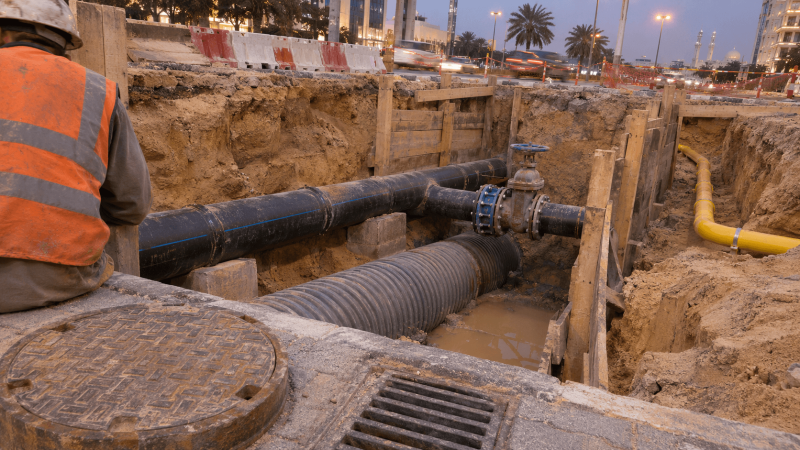
Every morning, millions of people turn on a tap, flush a toilet, light a gas stove and drive down a dry road after a rainstorm — without giving a single thought to how any of it works. That is exactly the point. The best infrastructure is invisible. But just one or two metres below the pavement lies a second city: a dense, interconnected network of pipes, valves, chambers and access points that keeps the city above it alive.
This hidden city carries four essential flows: drinking water coming in, wastewater going out, natural gas feeding homes and industry, and stormwater draining away before it floods the streets. Each system has its own engineering logic, its own risks — and its own materials. In this article, we follow these hidden networks underground and look at the products that keep them running: HDPE pipes, valves, manhole covers and drainage grilles.
A Second City, Built Out of Sight
If you could lift the asphalt off any modern city, you would see a layered maze. Water mains run under pressure in one trench. Gravity sewers slope gently in another, deeper one. Gas lines are kept apart for safety. Storm drains collect runoff from roads, roofs and car parks. Telecoms and power cables weave between them all.
What ties this maze together are three types of component:
- Conduits — the pipes that carry the flow.
- Control points — the valves, hydrants and joints that regulate, isolate and protect the flow.
- Access points — the manholes, chambers and grilles that let water in and let people reach the network for inspection and repair.
Get any of these wrong and the consequences surface quickly: leaks, contamination, collapsed roads, flooded streets and costly emergency excavations. Get them right and the network can quietly serve a city for generations.
Layer One: Drinking Water — Pressure, Purity and the Leakage Problem
Drinking water networks are pressurised systems. Water is pushed from treatment plants and reservoirs through transmission mains, then distributed through smaller pipes to every building. Because the system is under constant pressure, every weak joint and every corroded section is a potential leak.
The scale of that problem is enormous. Water that is treated and pumped but never reaches a paying customer is known as non-revenue water (NRW). A widely cited 2019 study by Liemberger and Wyatt estimated global NRW at around 126 billion cubic metres a year, worth roughly US$39 billion. A large share of that is lost through physical leaks and pipe bursts in ageing networks.
This is where pipe material becomes a strategic decision, not just a technical one. HDPE (high-density polyethylene) pressure pipes, particularly those made from PE100 grade resin, have become a preferred choice for modern water networks because they offer:
- Corrosion resistance — HDPE does not rust or suffer electrochemical corrosion like metal pipes.
- Fusion-welded joints — butt-fusion and electrofusion create joints as strong as the pipe itself, dramatically reducing joint leakage.
- Flexibility — HDPE tolerates ground movement, settlement and seismic activity far better than rigid materials.
- Smooth internal walls — low friction means stable flow capacity over the pipe's life, with minimal scaling.
- Long service life — international standards set a 50-year design basis for PE pressure pipes, and the European plastic pipe association TEPPFA and the PE100+ Association report an expected service life of more than 100 years under normal operating conditions.
For utilities fighting water loss, replacing leaking legacy mains with properly installed PE100 pipe is one of the most effective long-term investments available.
Layer Two: Wastewater — Gravity's Silent Highway
If drinking water arrives under pressure, wastewater mostly leaves by gravity. Sewer networks are designed with carefully calculated slopes so that sewage flows downhill to pumping stations and treatment plants. That makes sewers deeper, larger and far less forgiving of mistakes: a sagging pipe or broken joint can cause blockages, infiltration of groundwater, or exfiltration of sewage into the soil.
Sewers are also a chemically aggressive environment. Decomposing sewage releases hydrogen sulphide gas, which can turn into sulphuric acid on pipe walls and gradually eat away at concrete and metal.
This is why structured-wall HDPE sewer pipes — including double-wall corrugated and steel-reinforced designs — are increasingly specified for gravity sewers and large-diameter drainage. Their key advantages include:
- Chemical resistance to acids, sulphides and industrial effluents.
- High ring stiffness (rated in SN classes) to withstand soil and traffic loads when buried.
- Lightweight handling compared with concrete, which reduces installation time, equipment needs and trench costs.
- Watertight joints that keep sewage in and groundwater out.
For large municipal and industrial projects, the right ring stiffness, diameter and jointing system are decisive for long-term structural performance.
Layer Three: Gas Distribution — The Network That Must Never Fail
Natural gas networks carry the highest consequences of failure. A leaking water pipe is costly; a leaking gas pipe can be catastrophic. Gas distribution therefore relies on strict separation from other utilities, rigorous material standards and reliable isolation points.
Polyethylene has been used for low- and medium-pressure gas distribution for decades, valued for the same reasons it excels in water: no corrosion, fused leak-free joints and flexibility against ground movement. Equally important are the valves that allow operators to isolate sections of the network instantly during maintenance or emergencies. In any gas system, the quality of these control points is a matter of public safety.
Layer Four: Stormwater — The System That Sleeps Until It Can't
Stormwater infrastructure has an unusual job: it may sit idle for months, then must handle enormous volumes in a matter of hours. Roads, roofs and paved surfaces send rainfall rushing toward drains, and if the network cannot absorb it, the water stays on the streets.
The Gulf region learned this lesson dramatically in April 2024. The UAE recorded its heaviest rainfall since records began in 1949, with the Khatm Al Shakla area in Al Ain receiving 254.8 mm in under 24 hours — far more than the country's typical annual total. Widespread flooding across the emirates showed how critical stormwater capacity is, even in arid climates where heavy rain is rare.
Effective stormwater systems depend on:
- Drainage grilles and gratings that capture surface runoff quickly without clogging, while carrying traffic loads safely.
- Large-diameter HDPE drainage pipes that move high volumes efficiently and resist abrasion from sand and debris.
- Access chambers and manholes for inspection, desilting and maintenance — because a blocked drain is a useless drain.
As climate patterns grow more extreme, cities are re-evaluating drainage capacity, and the materials chosen today will determine how they cope with tomorrow's storms.
The Control Points: Valves, Hydrants and Dismantling Joints
Pipes carry the flow, but valves control it. Without them, a single burst main could force a utility to shut down an entire district. Well-placed valves allow operators to isolate a small section, repair it and restore service fast.
The most common types underground include:
- Gate valves — the workhorse of water distribution, used for full isolation of pipe sections. When open, they offer minimal flow restriction.
- Butterfly valves — compact and lighter, ideal for larger diameters and for regulating flow in transmission mains and pumping stations.
- Dismantling joints — the unsung heroes of valve chambers, allowing valves and fittings to be installed, removed and replaced without cutting the pipeline.
- Fire hydrants (ground and underground) — the network's emergency outlets, which must work perfectly on the rare day they are needed.
- Irrigation hydrants — distribution points for agricultural and landscape water networks.
Valve reliability is easy to overlook because valves may sit untouched for years. But when an emergency happens, a seized or leaking valve can turn a minor repair into a major outage.
The Doorways: Manhole Covers and Drainage Grilles
Manhole covers are the only part of the underground city most people ever see — and they carry a surprising amount of responsibility. A cover must bear traffic loads, resist theft and vandalism, stay seated without rocking, and allow quick access for maintenance crews. A failed cover is not just an infrastructure problem; it is a direct hazard to pedestrians and drivers.
Covers and gratings are commonly specified according to the European standard EN 124, which classifies them by load class based on the location where they will be installed:
|
Load class |
Test load |
Typical location |
|---|---|---|
|
A15 |
15 kN |
Pedestrian and cycle areas only |
|
B125 |
125 kN |
Footways, pedestrian zones, car parks |
|
C250 |
250 kN |
Kerbside channels and road edges |
|
D400 |
400 kN |
Carriageways of roads, highways |
|
E600 |
600 kN |
Industrial areas, loading yards |
|
F900 |
900 kN |
Airports, docks, very heavy wheel loads |
A practical rule many engineers follow: when in doubt, specify the higher class. Under-specifying a cover to save cost is one of the most common — and most avoidable — infrastructure mistakes.
Ductile cast iron remains the material of choice for heavy-duty covers because it combines high strength with resistance to cracking under repeated impact loads. Drainage grilles follow the same load logic, with the added requirement of sufficient open area to capture runoff efficiently during heavy rain.
Choosing Materials for a Network That Must Last Decades
Underground infrastructure is expensive to install and even more expensive to dig up and replace. That makes procurement decisions some of the most consequential in any project. Before sourcing, project teams should confirm:
- Application and medium — potable water, sewage, gas or stormwater each demand different materials and standards.
- Pressure and load ratings — PN/SDR ratings for pressure pipes, SN ring stiffness for buried gravity pipes, and EN 124 load classes for covers and grilles.
- Standards and certification — products should comply with the standards specified by the project and local authority, backed by test reports and quality documentation.
- Jointing and compatibility — pipes, fittings, valves and joints must work together as a system.
- Lifecycle cost, not just unit price — a cheaper pipe that leaks or corrodes early is the most expensive option over 50 years.
- Supply reliability — large infrastructure projects need consistent quality and on-time deliveries across multiple shipments.
Sourcing Underground Infrastructure Materials with Prime Petrochem
At Prime Petrochem, we work at the point where raw materials meet real-world infrastructure. From our base in Business Bay, Dubai, we supply industrial buyers across international markets with petrochemicals, polymers, metals and a growing range of industrial and infrastructure products — including HDPE pressure water pipes made from PE100, structured-wall HDPE sewerage pipes, gate valves, butterfly valves, dismantling joints, fire and irrigation hydrants, and ductile cast iron manhole covers in multiple sizes and load classes.
Because we also trade in the polyethylene resins and steel that these products are made from, we understand the full value chain — from polymer and metal to the finished pipe, valve and cover buried beneath a city street. Through our global sourcing network and reliable international logistics, we help contractors, utilities and distributors source the materials that keep the city beneath the city working.
Planning a water, sewerage or drainage project? Request a quote or contact our team on +971 56 211 0055 to discuss specifications, quantities and delivery.
Frequently Asked Questions
Why are HDPE pipes used for drinking water networks? HDPE pipes resist corrosion, are joined by fusion welding into leak-tight systems, tolerate ground movement and keep a smooth bore for decades. PE100 pipes have a 50-year design basis and an expected service life of more than 100 years under normal conditions.
What is the difference between HDPE pressure pipes and corrugated HDPE sewer pipes? Pressure pipes are solid-wall pipes rated for internal pressure (PN/SDR) and used for water supply. Corrugated or structured-wall pipes are designed for gravity flow, rated by ring stiffness (SN) to resist burial and traffic loads, and used for sewerage and stormwater.
Which valve is best for water distribution — gate or butterfly? Gate valves are typically used for full isolation in distribution networks, while butterfly valves are more compact and economical in larger diameters and for flow regulation. Many networks use both.
What load class of manhole cover do I need for a road? Under EN 124, carriageways of roads typically require class D400 as a minimum. Industrial yards may need E600, and airports or ports F900. When in doubt, choose the higher class.
Why do cities need stormwater drainage even in dry climates? Rare but intense rainfall events — such as the UAE's record April 2024 storm — can overwhelm streets in hours. Adequate drainage grilles, pipes and chambers prevent flooding, protect property and keep roads open.